

Managing a private parking lot in 2026 is about more than just painting lines and putting up a sign. It’s about turning an underused asset into a source of passive income and community value. Whether you own a small business, manage a church property, or simply have an empty driveway near a popular venue, understanding the rules, rights, and modern tools available is the first step toward effective management. This guide will walk you through the essentials of defining, managing, and monetizing your private parking lot using the latest digital tools and scannable signage.
What is a Private Parking Lot? Definitions and Distinctions
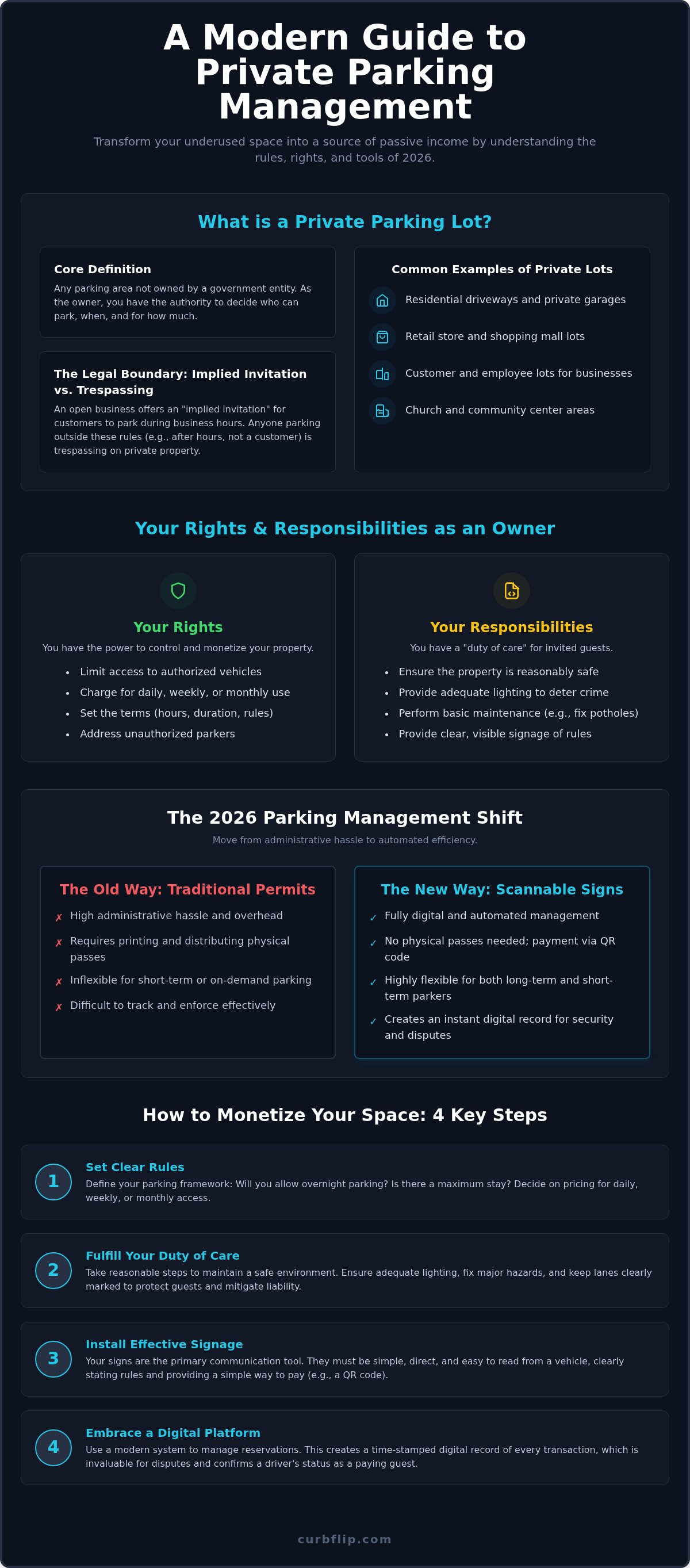
At its core, a private parking lot is any parking area that is not owned by a government entity. It is private property, owned by an individual, a family trust, a business, or a non-profit organization like a church or community center. This distinction is the foundation of your rights and responsibilities as an owner.
Unlike public street parking or municipal garages, which are governed by city and state traffic laws, a private lot operates under the rules set by the property owner. This gives you the authority to decide who can park, when they can park, and how much it costs. Common examples of private parking lots include:
- Residential driveways and private garages
- Retail store and shopping mall parking lots
- Customer and employee lots for private businesses
- Church and community center parking areas
- Paid lots near airports, stadiums, and event venues
A key legal concept to understand is the "implied invitation." When a business is open, it extends an implied invitation for customers to park in its lot. However, this invitation is not unlimited. It doesn't apply after business hours or to individuals who are not patronizing the business. When someone parks without permission or outside the established rules, they are trespassing on private property.
The Legal Boundary: Public vs. Private
The line between public and private property can sometimes feel blurry, especially for lots that are "open to the public." It’s a common misconception that if a lot is accessible, it must be public property. This is incorrect. A retail parking lot is private property made available for public use under specific conditions (i.e., for customers during business hours). The owner retains the right to set rules, enforce them, and revoke access.
This legal status means that standard traffic laws, like those for speeding or specific moving violations, may not be enforceable by police in the same way they are on a public road. However, more serious offenses can still be prosecuted. As the owner, your primary power lies in controlling access to your property. You can establish your own set of rules, such as time limits, designated zones for employees, and fees for parking.
Common Uses for Private Lots in 2026
The "sharing economy" has transformed how we view private assets, and parking is no exception. In 2026, a private lot is a dynamic resource. Homeowners near stadiums or concert halls can monetize their driveways during events, providing a valuable service while earning significant income. Churches with lots that sit empty during the work week can offer monthly parking to nearby office workers, creating a new, consistent revenue stream for their ministries. Businesses can also manage overflow parking or designate specific zones for employees, ensuring their most valuable spaces are always available for customers. The key to unlocking this potential is a management system that is both easy for the owner and simple for the driver.
Rights and Responsibilities of Private Lot Owners
As the owner of a private parking lot, you have a distinct set of rights that empower you to control and monetize your property. You have the fundamental right to limit access, charge for use, and set the terms under which people can park. This means you can decide the hours of operation, the duration of stays, and the price for daily, weekly, or monthly parking.
A crucial element of exercising these rights is providing clear "notice." Legally, you must inform potential parkers of the rules before they can be enforced. This is almost always accomplished through clear, visible signage. If you're looking for professional, high-quality displays for your property, you can check out Signarama. A sign at the entrance stating "Private Property: Paid Reservation Required" or "Permit Parking Only" establishes the terms of use. Without this notice, your ability to address unauthorized parkers is severely limited.
Alongside these rights come responsibilities. You have a "duty of care" to ensure your property is reasonably safe for invited guests (i.e., paying parkers). This includes basic maintenance like fixing large potholes, ensuring adequate lighting to deter crime, and keeping the area free of obvious hazards. Fulfilling this duty not only protects your guests but also mitigates your own liability.
Setting Your Own Parking Rules
Effective management begins with clear rules. Before you can automate or monetize, you need to decide how your lot will operate. Consider these common frameworks:
- "Permit Only" vs. "Paid Reservation": Traditional permits (like hang-tags) are fading in popularity due to the administrative hassle. A modern "Paid Reservation" system, managed digitally, is far more flexible. It allows you to serve both long-term monthly parkers and short-term visitors without printing physical passes.
- Time Limits and Restrictions: Will you allow overnight parking? Is there a maximum stay? Defining these limits prevents vehicles from being abandoned and ensures a steady turnover of space if you're charging by the hour or day.
- Effective Communication: Your signage is your primary communication tool. It should be simple, direct, and easy to read from a vehicle. A sign that clearly states the rules and provides a simple way to pay (like scanning a QR code) prevents confusion and conflict.
Liability and Safety Considerations
Liability is a primary concern for property owners, but it's more manageable than many think. Your duty of care means taking reasonable steps to maintain a safe environment. Well-lit spaces and clearly marked lanes are essential first steps. However, modern digital platforms add a powerful layer of protection that traditional methods lack.
When a driver books a spot through a platform like CurbFlip, it creates a digital record of the transaction. This time-stamped reservation confirms their status as an invited, paying guest and documents the agreed-upon time frame. This digital paper trail is invaluable in the event of a dispute or an accident, clearly defining who was authorized to be on your property and when. It removes the ambiguity of cash-in-a-box honor systems and provides a professional layer of documentation that protects you as the property owner.
Scannable Signs vs. Traditional Permits: The 2026 Comparison
For decades, managing a private parking lot meant dealing with a mountain of administrative tasks: designing and printing physical permits, tracking payments in a spreadsheet, and manually checking cars. In 2026, this model is obsolete. The rise of scannable QR-code-based signs has created a more efficient, profitable, and user-friendly system.
The fundamental difference lies in automation and accessibility. Traditional permits are a closed system; you have to find the lot manager, fill out paperwork, and wait for a physical tag. Scannable signs create an open, on-demand marketplace. A driver can pull up, scan a code with their smartphone, pay, and be legitimately parked in under a minute. This shift closes the "Enforcement Gap"—the space where frustration and confusion lead to unauthorized parking. When paying is fast and easy, compliance rates skyrocket, and the need for confrontational enforcement like towing plummets.
| Feature | Traditional Permits (Hang-Tags) | CurbFlip Scannable Signs |
|---|---|---|
| Overhead Cost | High (printing, mailing, staff to distribute) | Low (one-time sign purchase, no physical materials) |
| Implementation Speed | Slow (days or weeks for permit distribution) | Instant (set up your digital listing in minutes) |
| Driver Experience | Clunky (requires pre-registration, risk of losing permit) | Seamless (scan, pay, and park; no app download required) |
| Flexibility | Poor (difficult to manage short-term or guest parking) | Excellent (easily set rates for hourly, daily, or monthly stays) |
| Security | Low (permits can be lost, stolen, or counterfeited) | High (digital reservations are unique and time-stamped) |
Why Traditional Permits are Fading Out
The decline of physical permits is driven by their inherent inefficiencies. The cost of printing and distributing hang-tags or decals adds up, especially for lots with high turnover. They are difficult to manage for mixed-use properties that need to accommodate both long-term tenants and short-term visitors. Furthermore, physical permits are susceptible to fraud. A determined person can photocopy a permit or share it with friends, undermining your revenue and control. This system requires constant manual oversight, which is precisely the kind of time-consuming work modern property owners want to avoid.
The Rise of CurbFlip Scannable Parking Signs
CurbFlip represents the new standard for private lot management. The system is built on a simple, powerful idea: a single, durable sign can replace an entire gate system, a ticket machine, and a full-time attendant. The process is elegantly simple for the driver. They pull up to your space, open their phone's camera, and scan the QR code on the sign. This instantly opens a secure webpage—no app download is necessary—where they can see your rates, select the duration of their stay, and pay with a credit card or digital wallet.
For the property owner, the benefits are even greater. You receive an instant notification of the new reservation and payment. Your online dashboard provides a real-time view of who is parked in your lot, how long they've paid for, and how much revenue you've generated. This transforms your lot from a passive patch of asphalt into an active, data-rich digital asset. You can adjust your pricing for special events, block out dates for private use, and manage everything from your smartphone. The CurbFlip Scannable Parking Signs system provides the control of a commercial garage with the simplicity needed for a private homeowner or small business.
How to Monetize Your Private Space in 5 Easy Steps
Turning your empty space into a reliable source of passive income is easier than you think. By following a clear, structured process, you can launch your private parking business and start generating revenue quickly. The key is to combine a smart strategy with powerful automation tools.
- Assess Your Space and Capacity. Start by understanding what you have to offer. How many standard vehicle spots can you comfortably fit? Measure the space and mark out clear spots if necessary. Note any special features, like coverage from the elements or suitability for larger vehicles like RVs or trucks, as these can command higher prices.
- Analyze Local Demand. Your lot's value is directly tied to its location. Are you near a major airport, a university, a hospital, a sports stadium, or a popular beach? These are "parking deserts" where demand far outstrips supply. Use online maps to identify nearby points of interest and research what commercial garages in the area are charging. This will help you find your competitive edge.
- Set Your Pricing Strategy. Flexibility is key. You can create different rates for different needs. Offer hourly or daily rates for transient parkers, like concert-goers or tourists. Provide weekly rates for business travelers or vacationers. And offer monthly rates to create a stable, recurring revenue base from local commuters or residents who need a permanent spot.
- Order and Install Scannable Signage. This is the step that automates your business. Instead of a cash box and honor system, install a professional, weatherproof CurbFlip sign at the entrance to your lot or at each individual spot. The sign does the work for you, presenting your rules and processing payments 24/7. Installation is simple, often requiring just a few screws to mount on a post, wall, or fence.
- Launch Your Listing on a Digital Marketplace. To maximize visibility, list your space on a digital parking marketplace like CurbFlip. This puts your lot in front of thousands of drivers actively searching for parking in your area. You'll create a profile with photos, a description of the space, your availability, and your pricing. Once live, drivers can pre-book your spot online or pay on-site using your scannable sign.
Identifying High-Value Parking Windows
The most successful private lot owners are experts at identifying windows of opportunity. A church parking lot, for example, is a high-value asset during the 9-to-5 workday, when it's typically empty. A residential driveway near a football stadium becomes a goldmine on game days. A home in a coastal town can offer beach parking during the busy summer season. By analyzing the rhythm of your neighborhood, you can capitalize on peak demand and turn your lot's downtime into profitable uptime.
Automating the Reservation Process
True passive income requires automation. A modern platform lets the software do the heavy lifting. CurbFlip's system handles the entire customer lifecycle without you needing to be present. It processes secure payments, sends automated confirmation and reminder emails to drivers, and keeps a clean, organized schedule of all your bookings. The scannable signs act as your on-site verification tool, allowing you to quickly check if a vehicle has an active, paid reservation just by looking it up on your phone. This is how you manage a bustling private lot from anywhere in the world, with zero on-site presence required.
CurbFlip: Your Partner in Private Parking Success
CurbFlip was built to bridge the gap between the physical reality of a parking space and the digital world of on-demand bookings. We provide property owners—from individual homeowners to large community organizations—with the tools to participate in the sharing economy effortlessly. Our platform is more than just a payment processor; it's a complete management system designed for simplicity and profitability.
We support a diverse range of needs, from high-demand event parking near stadiums to secure monthly storage for trucks and RVs. The "neighborly" advantage is at the heart of what we do. We empower individuals and small organizations to compete with large, impersonal commercial garages by offering a more convenient and often more affordable option. By removing the friction of traditional parking—no valets, no gates, no risk of towing—we create a simple, stress-free experience for both the property owner and the driver.
The CurbFlip Scannable Sign System
Our core innovation is the CurbFlip Scannable Sign System. These signs are the physical touchpoint for your digital business. They are designed to be easily integrated into any property. You can customize your signs with your specific rules, time limits, and branding. The "Scan-to-Pay" workflow is a game-changer for capturing spontaneous, drive-up parkers who may not have pre-booked online. It ensures you never miss a revenue opportunity. For a deep dive into how these signs can transform your property, explore our complete guide to passive parking income in 2026.
Join the Sharing Economy Today
If you have an empty or underutilized parking space, you have an untapped revenue stream. CurbFlip provides the most accessible and low-cost way to start a parking business. There's no expensive hardware to install and no staff to hire. Our platform has helped countless property owners turn their empty driveways, lots, and garages into sources of steady monthly income.
Don't let your valuable space sit empty. Start your journey toward easy, automated, and stress-free parking management. With the right tools, you can build a profitable side business that runs itself.
Frequently Asked Questions (FAQs)
- Is it legal to charge for parking in my own driveway?
-
In most residential areas, yes. As the property owner, you have the right to rent out your private space. However, it's always wise to check with your local municipality or Homeowners Association (HOA) to ensure there are no specific ordinances or covenants that prohibit it.
- What happens if someone parks in my private lot without paying?
-
If someone parks on your property without authorization, they are trespassing. While platforms like CurbFlip dramatically reduce unauthorized parking by making payment easy, they are not enforcement services. The property owner is responsible for dealing with trespassers, which typically starts with leaving a note or, as a last resort, contacting a local towing company that operates in compliance with local laws.
- Do I need special insurance to run a private parking lot?
-
It's a good idea to speak with your homeowner's or commercial property insurance provider. Some policies already cover this type of activity, while others may require an affordable rider or add-on for commercial use. Being transparent with your insurer is the best way to ensure you're fully covered.
- How do scannable parking signs work for drivers who don’t have an app?
-
This is a key advantage of the CurbFlip system. There is no app to download. When a driver scans the QR code with their smartphone's camera, it opens a secure mobile website directly in their browser. This removes a major point of friction, making it fast and easy for anyone with a smartphone to pay and park.
- Can I offer monthly parking for large vehicles like trucks or RVs?
-
Absolutely. If you have the space, there is high demand for secure, long-term parking for commercial trucks, RVs, boats, and trailers. You can specify the types of vehicles your space can accommodate in your CurbFlip listing and set a competitive monthly rate.
- What is the difference between public parking and a private lot open to the public?
-
Public parking is owned and operated by a government entity (like a city or state). A private lot "open to the public" (like a grocery store lot) is still private property. The owner allows public access for a specific purpose (e.g., shopping) and retains the right to set rules and remove anyone who violates them.
- How do I set the right price for my private parking spot?
-
Research is key. Look at what nearby commercial garages, municipal lots, and other private sellers on platforms like CurbFlip are charging. Consider your location's advantages (e.g., proximity to an event, covered parking). You can often price slightly below large commercial garages to attract value-conscious drivers while still earning substantial income.
- Do I need to install expensive gates or cameras to manage my lot?
-
No. This is the beauty of a system based on scannable signs. The combination of clear signage, easy mobile payments, and a digital reservation system eliminates the need for expensive hardware. It's a low-overhead model that maximizes your profit margins from day one.
Disclaimer
The content provided in this article is for informational purposes only. All uses of the CurbFlip name, images, logos, and likeness are the exclusive property of CurbFlip.com. This article may contain information researched by a third-party, meaning CurbFlip does not guarantee the accuracy, completeness, or reliability of any third-party information presented herein and assumes no liability for any decisions made or actions taken based on this content.


