

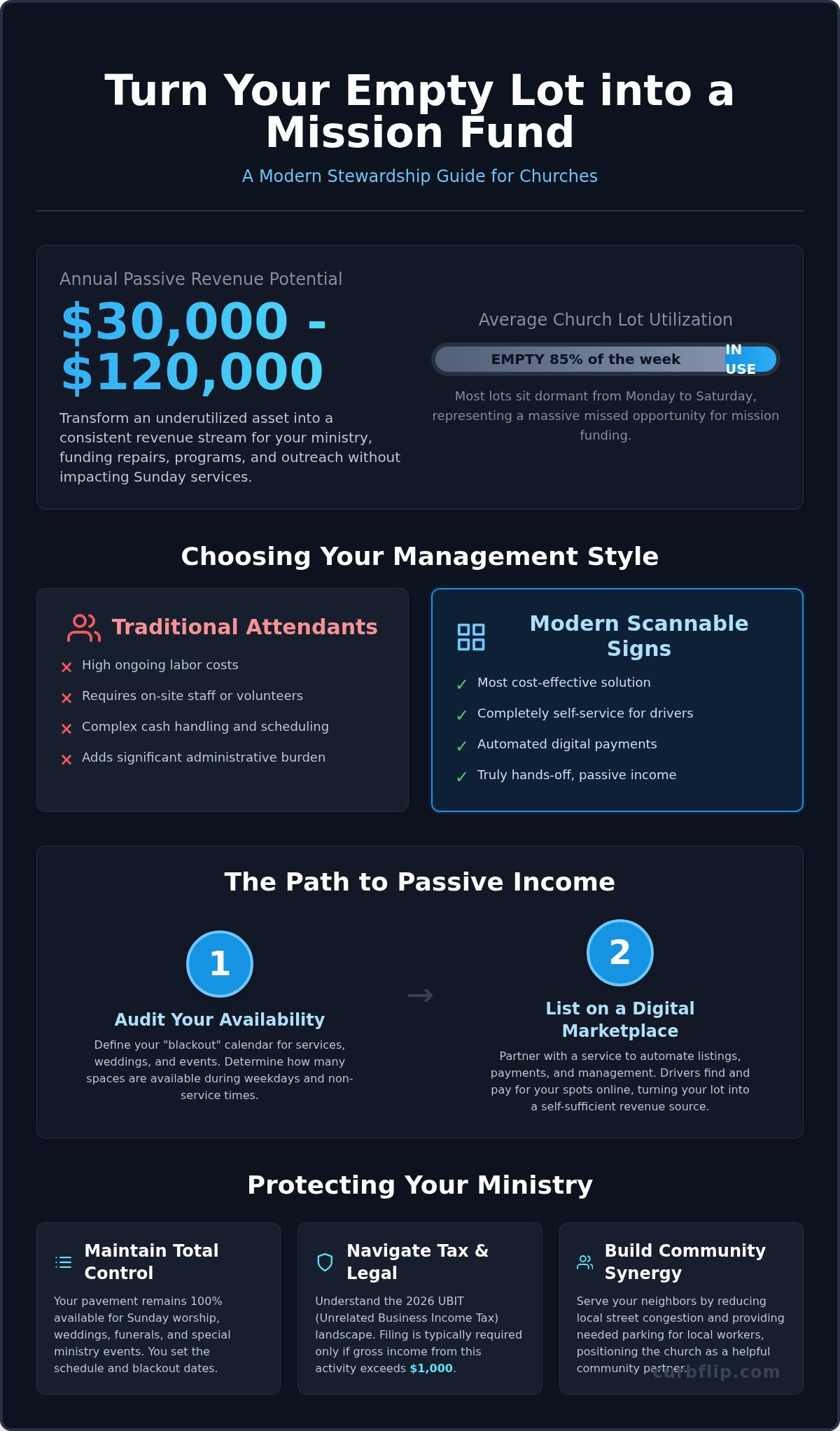
Most congregations can net between $30,000 and $120,000 per year when they choose to monetize church parking lot spaces during non-service times. It's a common struggle. You have a massive lot that costs a fortune to maintain, while tithes are harder to come by and your pavement sits empty all week. You want to be a good neighbor, but those maintenance bills don't pay themselves.
You can transform your empty weekday parking into a consistent, hands-off revenue stream for your ministry without ever disrupting your Sunday services. We'll show you how to turn that asphalt into a tool for modern stewardship. This guide covers everything you need to succeed in 2026, from navigating the $1,000 UBIT gross income filing threshold to using scannable signs that act as your invisible attendant. You'll gain total control over your property and clear legal boundaries while securing the financial future of your mission.
Key Takeaways
- Discover how to leverage your location to turn a lot that sits empty 85% of the week into a valuable community asset that funds your mission.
- Learn why scannable parking signs are the most cost-effective way to manage your property without the high cost of hiring on-site staff.
- Find out how to monetize church parking lot spaces while keeping your pavement 100% available for Sunday worship and special ministry events.
- Understand the 2026 tax landscape, including UBIT filing thresholds and how to protect your non-profit status while generating revenue.
- Follow a simple, two-step process to audit your available spaces and list them on a digital marketplace for immediate passive income.
The Opportunity: Why Your Empty Lot is a Mission Asset
Your church's property is more than just a place for worship; it's a significant physical asset that often sits underutilized. Statistics show that the average church parking lot remains empty approximately 85% of the week. While these spaces are packed on Sunday mornings, they represent thousands of square feet of dormant potential from Monday through Saturday. For urban and suburban ministries located near transit hubs, office buildings, or medical centers, this empty pavement is a missed opportunity to fund your mission.
When you choose to monetize church parking lot spaces, you aren't just running a business; you're practicing modern stewardship. You're taking a resource you already own and turning it into outreach funding. In simple terms, church parking monetization is the process of allowing the public to use your lot for a fee during non-service hours. This income can pay for roof repairs, youth programs, or community food banks that might otherwise struggle for funding.
To understand how these spaces fit into broader parking concepts, one must look at the local supply and demand. Many cities face a chronic shortage of affordable spaces, making your lot a highly valuable commodity for daily commuters and local employees.
Passive Income vs. Active Management
The biggest hurdle for most congregations is the fear of added work. You don't want your staff or volunteers stuck in a "manned" parking booth or dealing with cash payments. Traditional management is a headache. Thankfully, 2026 technology has shifted the model toward a completely self-service experience for drivers. By using a digital marketplace, you can automate the entire process. Drivers find your lot online, reserve a spot, and pay through their phones. This allows you to generate revenue without needing a single person on-site to manage the gate. It's truly hands-off income that respects your team's time.
Community Impact and Neighborhood Synergy
Opening your lot does more than just fill your bank account; it serves your neighbors. When you monetize church parking lot areas, you help reduce local street congestion. Instead of drivers circling the block and adding to traffic, they have a designated, secure place to go. This builds a bridge with the local business community. You're helping local workers find reliable parking while simultaneously making the neighborhood more accessible. It's a win-win scenario that positions the church as a helpful, proactive partner in the community's daily life.
Stewardship or Business? Balancing Ministry and Revenue
Some leaders worry that choosing to monetize church parking lot spaces feels more like a business venture than a ministry. It's a valid concern. However, shifting your perspective from "profit" to "provision" changes the narrative. You aren't just selling pavement; you're harvesting a dormant resource to fund your core mission. Whether it's fixing a leaking roof or expanding a food pantry, these funds provide the "fuel" for your spiritual work.
The "Sunday Sanctuary" remains your top priority. Shared use doesn't mean giving up control. You decide exactly when the lot is open for public use and when it's reserved for the congregation. For example, a small congregation in a bustling urban center recently used their weekday parking revenue to fully fund a local youth mentorship program. They didn't lose their identity as a place of worship; they simply gained the financial freedom to serve their community more deeply. Beyond the internal financial boost, there are significant community benefits of shared parking that align with a church's heart for service, such as reducing the environmental impact of new construction.
Defining Your Usage Policy
Clarity is the key to a stress-free experience. You'll want to establish a firm "blackout" calendar that accounts for more than just Sundays. Consider weddings, funerals, and holiday services where the lot must be 100% available for members. You also need to decide if you want to host daily commuters, who come and go, or monthly parkers, who provide a more predictable check. Clear, professional signage is essential here. It should communicate that while the lot is open for paid use, church events always take precedence. Setting these boundaries early ensures peace of mind for your board and your members. You can start exploring how to list your church parking spaces to see how others are balancing these specific needs.
Communicating with the Congregation
Transparency builds trust. When you first propose the idea to monetize church parking lot areas, explain exactly where the money will go. If members know the "parking fund" is paying for the new nursery carpet or the upcoming mission trip, they're much more likely to support it. Address concerns about security and "wear and tear" by explaining how modern digital systems track every vehicle. You can even invite members to use the system for their own guests during the week, making the new technology a benefit for everyone involved in the church family.
QR Codes vs. Attendants: Choosing Your Management Style
Choosing your management style determines whether your new revenue stream feels like a blessing or a second job. In the past, churches relied on physical attendants or plastic hang-tags to track visitors. Both methods are flawed. Hiring a person to sit in a booth introduces high overhead costs and significant liability issues. Managing a stack of physical permits creates an administrative nightmare for your office staff. If you want to successfully monetize church parking lot spaces in 2026, you need a digital-first approach.
Scannable parking signs have replaced the need for manual oversight. These signs provide a scannable link that allows drivers to book and pay in seconds. You get real-time visibility through a digital dashboard, showing exactly who is in your lot at any moment. This transparency ensures security without the need for constant on-site presence. Unlike long-term vehicle storage, which can lead to abandoned cars and security risks, active turnover through daily or monthly reservations keeps the lot fresh and safe.
The Benefits of Scannable Signage
Modern signage offers a professional look that respects your church's aesthetics while providing 24/7 utility. Because there are no expensive gates, kiosks, or heavy hardware to maintain, your initial investment stays incredibly low. Drivers appreciate the convenience; they don't have to download a specific app before arrival or fumble with cash. They simply scan, pay, and park. This frictionless experience encourages repeat customers and higher ratings for your lot, ensuring your pavement stays productive all week long.
Daily vs. Monthly Parking Revenue Models
Your revenue strategy should match your neighborhood's pulse. If your church is near a stadium, hospital, or major transit hub, a daily or hourly model often yields the highest returns. These high-turnover areas benefit from dynamic pricing where rates can increase during peak demand events. If you're located in a quiet office district, monthly reservations provide consistent, predictable income from local employees. Many ministries choose a hybrid model. They offer monthly spots for local workers during the week and keep some spaces open for daily visitors or weekend event overflow. This flexibility ensures you maximize every square foot when you monetize church parking lot assets. You can easily manage these different reservation types through a digital marketplace, giving you total control over your property's schedule.
Legal, Tax, and Safety: Protecting the Church
Protecting your ministry is just as important as growing its resources. When you decide to monetize church parking lot spaces, you must address the legal and fiscal realities that come with it. The good news is that these hurdles are manageable with the right information. You don't need a law degree to keep your church safe; you just need a clear plan and the right tools.
First, let's talk about taxes. As of July 2026, the IRS remains clear about Unrelated Business Income Tax (UBIT). If your church generates $1,000 or more in gross income from an unrelated business, such as a regularly operated parking lot, you must file Form 990-T. The tax rate for this income is a flat 21% on the net profit. If you expect to owe $500 or more for the year, you're required to make quarterly estimated payments. For the 2025 tax year, your Form 990-T is due by May 15, 2026. It's vital to consult with a tax professional to ensure your 501(c)(3) status remains secure while you grow this new revenue stream.
Liability is another common concern for church boards. Most standard church insurance policies are designed for worship activities, not commercial parking. Check with your provider to see if your current policy covers paid use. To mitigate risk, your physical signage should always include "Park at Your Own Risk" language. This sets a clear boundary between the church and the driver. While a digital platform provides the monitoring tools to see who is authorized, they don't provide on-site towing or enforcement. You maintain full control over how you handle unauthorized vehicles on your pavement.
Navigating the Tax Implications
Stay organized from day one. Keep a clear digital trail of all transactions for your annual reporting. Passive rental income is often viewed differently than active business ventures, but the $1,000 gross threshold still applies. By tracking your net income accurately, you can deduct expenses like lot maintenance and platform fees before calculating your 21% tax. This ensures you only pay what's legally required while keeping your mission funded.
Safety and Security Measures
A well-lit lot is a safe lot. Use a portion of your new revenue to upgrade lighting and visibility for your weekday users. Digital records are your best friend here. Because every driver is registered through the system, you know exactly who should be on your property at any given time. This record-keeping provides peace of mind for your congregation and your neighbors alike. You can start protecting your property today by ordering CurbFlip Scannable Parking Signs to establish clear rules and professional monitoring for every visitor.
Getting Started with CurbFlip Scannable Parking Signs
Ready to move from planning to performance? Setting up your lot is a straightforward process that respects your time and your property. Unlike other platforms that take a massive cut of your revenue, this model is built for property owners who want to keep more of what they earn. By following a few simple steps, you can monetize church parking lot spaces and start seeing deposits in your account within days.
- Step 1: Audit your lot. Walk your property and count how many spaces you can realistically spare during the week. Don't forget to account for staff needs or small mid-week ministry groups.
- Step 2: Create your listing. List your lot on the CurbFlip digital parking marketplace. This is where you describe your location, upload photos, and highlight your proximity to local landmarks.
- Step 3: Get your signage. Order your CurbFlip Scannable Parking Signs. These act as your 24/7 invisible attendant. Drivers scan the code, pay, and you get notified. Using these signs even reduces your online transaction fee from 5% to 0%.
- Step 4: Set your rules. You have total control over your calendar. Block out your Sunday mornings, Wednesday nights, or any upcoming special events with a single click.
Setting Your Rates for Maximum Occupancy
Pricing is a balance between revenue and occupancy. Look at the daily parking reservation rates in your specific neighborhood to stay competitive. In high-demand areas like Tucson or Sacramento, rates are rising; for example, Tucson meters now charge $1.50 per hour. You can offer "Early Bird" specials for commuters who arrive before 8 a.m. or adjust rates during local festivals to maximize your lot's potential. It's your property, so you decide the price that works best for your community.
Managing Your Digital Dashboard
Your dashboard is the command center for your lot. It's designed for ease of use, even for those who aren't tech-savvy. If a funeral is scheduled on short notice, you can block those spaces instantly to ensure your members have priority. You can also pull monthly reports to show your board of directors exactly how much you've earned and where the funds are going. This transparency makes it easy to prove that when you monetize church parking lot assets, you're making a smart, sustainable choice for the ministry's future. You can communicate directly with parkers through the platform, ensuring every transaction is professional and secure.
Fund Your Mission with Smart Parking Stewardship
Your church property is a powerful tool for provision. By utilizing the 85% of the week your lot sits empty, you can create a reliable revenue stream that directly funds your mission. We've explored how modern technology removes the stress of manual management while keeping your congregation's needs front and center. You can maintain clear legal boundaries and total control over your schedule without adding a single task to your staff's plate.
CurbFlip has been a trusted partner in the sharing economy since 2013. There are no monthly subscription fees to worry about; you only pay when you earn. Custom scannable signage provides a professional look that integrates perfectly with your church's aesthetic. It's time to stop letting your pavement sit idle and start putting it to work for your community.
Start Monetizing Your Church Lot with CurbFlip Today to see how easy it is to monetize church parking lot spaces. Your ministry deserves the financial freedom to grow and serve more effectively. Take the first step toward stress-free passive income and watch your outreach potential expand.
Frequently Asked Questions
Will monetizing our parking lot affect our church's tax-exempt status?
Your tax-exempt status remains secure, but you'll likely trigger a specific tax liability. As of July 2026, the IRS requires churches with $1,000 or more in gross unrelated business income to file Form 990-T. You'll pay a flat 21% tax on the net income generated from parking activities. This doesn't revoke your 501(c)(3) standing; it simply treats the parking revenue as taxable business income separate from your religious mission.
How do we ensure people don't park there during Sunday services?
You have total control over your lot's availability through a digital dashboard. Simply block out Sunday mornings, Wednesday nights, or any holiday services on your master calendar. When those times are blocked, the lot won't appear as an option for drivers on the marketplace. Professional signage also reinforces that church events always take precedence over public parking, ensuring your members always have a spot.
Do we need to install expensive gates or cameras?
No, expensive hardware isn't necessary to start earning. Scannable parking signs act as your "invisible attendant," allowing drivers to book and pay via their smartphones. This avoids the high cost and maintenance of physical gates or kiosks. While you can choose to add cameras for extra security, the core booking and payment system functions perfectly with just your custom, scannable signs and a smartphone.
What happens if someone parks in our lot without paying?
You can monitor your lot in real-time using a digital dashboard that shows every authorized vehicle. If a car isn't on your list, you follow your church's established enforcement policy. While the platform provides the monitoring data, the church maintains full authority to handle unauthorized parkers. Most congregations partner with local towing or ticketing services to manage their property's rules without needing staff on-site.
Is there a minimum number of spots we need to have to start?
You can begin with any number of spaces. There's no minimum requirement to list your property and start generating revenue. Whether you have five unused spots or fifty, you can monetize church parking lot assets to fund your specific ministry goals. Every space represents a new stream of passive income that can support local outreach, youth programs, or essential building repairs.
Can we choose to only rent to certain types of commuters?
Yes, you can tailor your listings to attract the specific users you prefer. You can choose to offer only monthly reservations if you want a consistent, predictable group of local employees. Alternatively, you can set "Early Bird" specials to attract professional commuters who arrive and depart during standard business hours. This flexibility allows you to maintain the "neighborly" vibe of your church while maximizing your lot's utility.
How much revenue can a typical church lot generate per month?
Revenue depends on your location, but most congregations net between $30,000 and $120,000 annually. In high-demand urban areas, monthly lease rates for a single space often range from $150 to $250. When you monetize church parking lot spaces, you're tapping into a consistent market. This income can quickly scale into thousands of dollars each month, providing a substantial boost to your church's annual operating budget.
Does CurbFlip handle the payment processing and receipts?
The platform automates the entire payment process for you. Drivers pay securely through the digital marketplace, and the system instantly generates their receipts. This removes the administrative burden from your church office and ensures every transaction is tracked accurately for your records. You'll receive your funds directly, while the system handles the complexities of secure transactions and digital record-keeping for every parker.
Disclaimer
The content provided in this article is for informational purposes only. All uses of the CurbFlip name, images, logos, and likeness are the exclusive property of CurbFlip.com. This article may contain information researched by a third-party, meaning CurbFlip does not guarantee the accuracy, completeness, or reliability of any third-party information presented herein and assumes no liability for any decisions made or actions taken based on this content.


