

What if the "free" public spot you just found actually costs you more in stress and potential fines than a reserved private space? We've all been there, circling the block for twenty minutes while the clock ticks toward an important meeting. It's exhausting to deal with cramped municipal lots or the constant anxiety of a surprise parking ticket. When you weigh the pros of private parking vs public parking, the real winner is usually the option that offers certainty.
You deserve a parking experience that doesn't feel like a gamble. In this guide, you'll discover how to save hours of wasted time, increase your vehicle's security, and even turn your unused pavement into a revenue stream. We'll explore the latest 2026 rate hikes and new transparency laws to show you how making the right choice is as simple as a quick reservation.
Key Takeaways
- Learn why choosing private parking vs public parking in 2026 means trading the stress of circling for the peace of mind of a guaranteed reservation.
- Discover how private spaces often provide enhanced security through better lighting and scannable access controls that municipal lots frequently lack.
- Explore how property owners can generate passive income by listing their driveways or lots for daily, weekly, or monthly rentals.
- Understand how CurbFlip Scannable Parking Signs remove the friction of manual management by offering drivers a fast and secure "Scan to Pay" experience.
Understanding the Basics: Public vs. Private Parking Defined
Getting a handle on Understanding the Basics: Public vs. Private Parking Defined starts with knowing who owns the pavement beneath your tires. Public parking refers to spaces managed by municipal or government entities. You'll typically find these as metered spots on busy city streets or within large municipal garages. These spots operate on a strict first-come, first-served basis. This setup often leads to the frustrating ritual of circling the block, which wastes both your fuel and your limited time.
Private parking offers a much more controlled and reliable environment. These spaces are owned by individuals, local businesses, or even neighborhood churches. This category ranges from professional commercial garages to simple residential driveways. Unlike public spots, private parking usually requires specific permission or a pre-arranged reservation. When you weigh the benefits of private parking vs public parking, the biggest shift is moving from a stressful game of chance to the certainty of a guaranteed spot.
To better understand how these laws and property rights differ in practice, watch this helpful video:
Legal Ownership and Access Rules
Private parking lots are strictly private property. This legal status means owners have the full authority to set their own rules, operating hours, and specific rates. They aren't forced to wait for city council votes to adjust a fee or change a policy. To make these boundaries clear and professional, many owners install CurbFlip Scannable Parking Signs. These signs instantly mark the space as private and provide a secure way for drivers to gain authorized access. It's an efficient system that replaces parking confusion with total clarity for everyone involved.
Key Differences: Why Private Parking Often Wins on Reliability
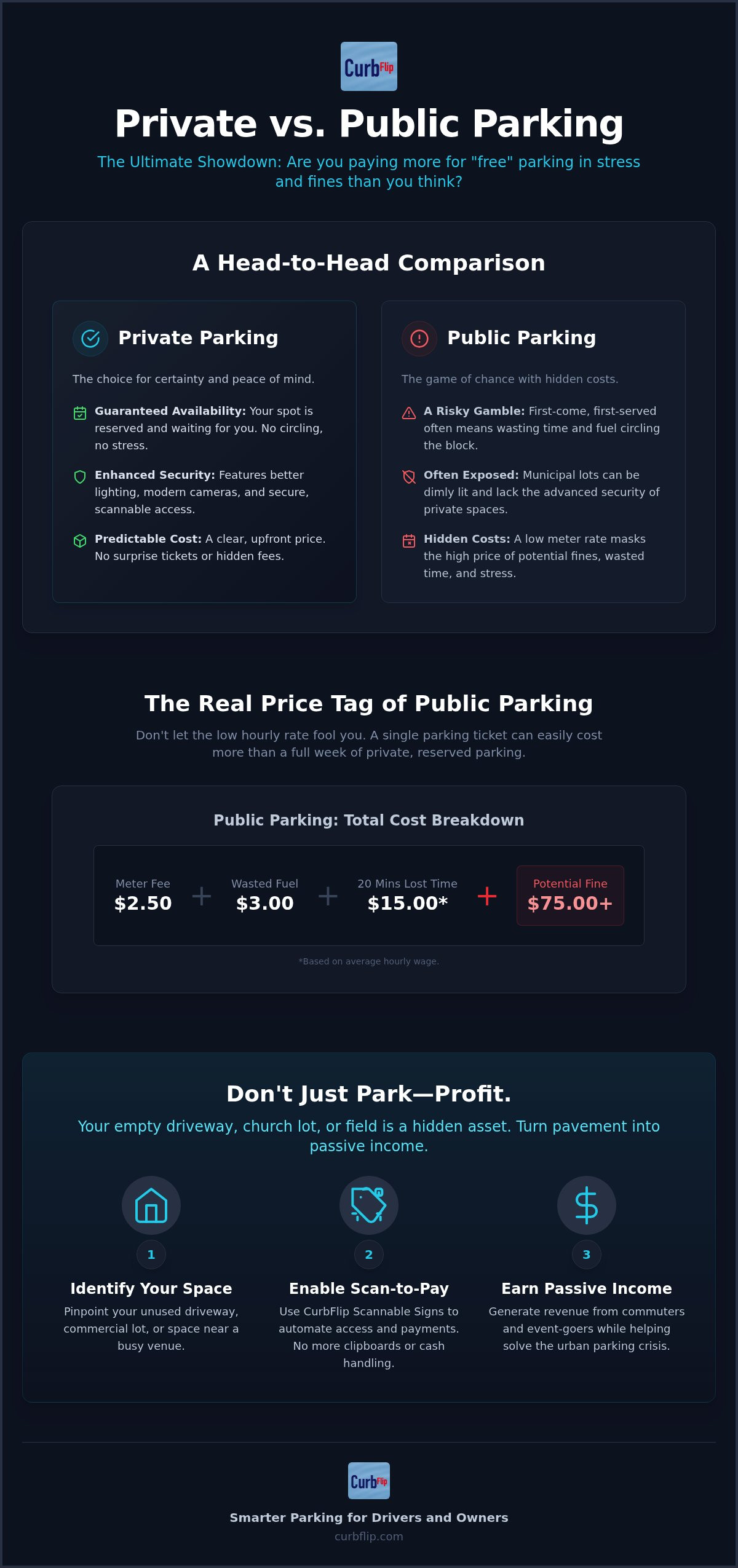
Public parking often feels like a game of musical chairs where the music never stops. While official government parking policies dictate how municipal lots are prioritized, they can't guarantee you a space when you're running late. Private parking flips the script by offering guaranteed entry through simple reservations. You save time and fuel by driving straight to your spot instead of wasting thirty minutes circling the block. This reliability makes private options the smarter choice for commuters and event-goers alike.
Security is a major factor in the private parking vs public parking debate. Private lots often invest in high-quality lighting, modern cameras, and scannable access controls to keep your vehicle safe. This is a far cry from the dimly lit municipal lots that often feel exposed. Don't let the low hourly rate of a public meter fool you, either. While those quarters seem cheap, a single municipal ticket can cost more than a full week of private parking. It's about looking at the total expense, including the hidden costs of stress and potential damage.
The 5-Step Value Comparison for Drivers
Use this quick checklist to decide which option fits your schedule and budget best:
- Check availability: Public spots are always a gamble; private reservations provide a guaranteed spot.
- Evaluate security: Choose private environments that offer controlled scannable access and superior lighting.
- Calculate total cost: Add up the price of gas, the value of your time, and the high cost of potential municipal fines.
If you're tired of the public parking lottery, you can find more secure options or even set up your own space with professional scannable signage.
Maximizing Your Space: The Private Parking Opportunity
The conversation around private parking vs public parking usually focuses on the driver's convenience. However, the 2026 landscape offers a massive opportunity for property owners to participate in the sharing economy. If you have an empty driveway, a church lot, or a field near a stadium, you're sitting on a potential revenue stream. You can rent your parking space to local commuters or event-goers, turning static pavement into active passive income. It's a neighborly way to help solve the urban parking crisis while padding your own bank account.
The traditional headache of managing a lot is gone. You don't need to stand outside with a clipboard or worry about chasing down cash transactions. Modern scannable signage removes all that friction. Drivers simply pull up, scan the sign with their phone, and pay instantly to secure their spot. It's a seamless handoff that gives the driver a secure, guaranteed space and puts money in your pocket without any manual effort on your part.
Managing Private Spaces with Scannable Signs
The "Scan to Pay" system is a game-changer for specialized locations like churches, beach-front properties, and stadiums. During big games or busy weekends, these areas often become battlegrounds for private parking vs public parking dominance. By using CurbFlip Scannable Parking Signs, you establish a professional, automated storefront for your space. This approach is perfect for daily rentals or high-traffic events because it handles the scheduling and payments for you. You get to set your own rules and rates while the technology manages the logistics. It's the most efficient way to monetize your property while providing a valuable, stress-free service to your community.
Take Control of Your Parking Future Today
Deciding between private parking vs public parking doesn't have to be a daily gamble. You now understand how private reservations eliminate the stress of circling the block and how advanced security features provide real peace of mind for your vehicle. Whether you're a driver looking for a guaranteed spot or a property owner ready to tap into the sharing economy, the tools for a better experience are already at your fingertips. You can join thousands of hosts who are already successfully monetizing their driveways and lots using secure, scannable QR technology for instant payments. It's the simplest way to turn an empty space into a reliable revenue stream while helping your neighbors find better places to park. Browse CurbFlip Scannable Parking Signs and start managing your space today! We're excited to help you transform your parking experience.
Frequently Asked Questions
Is a parking lot considered public or private property?
A parking lot's status depends entirely on its ownership. Public lots are managed by municipal or government entities like city councils. Private parking lots are owned by businesses, individuals, or organizations like churches. While both serve the same basic purpose, private lots allow owners to set their own rules and rates. Understanding this distinction helps you know who to contact for reservations or issues.
Can I get a ticket in a private parking lot?
Yes, you can receive a violation notice in a private lot. Unlike municipal tickets, these are typically private invoices issued for breaking the owner's specific rules. Local police can still issue official citations for fire lane or handicap space violations. Always check for scannable signs to ensure your stay is authorized and paid for to avoid any unexpected fines or complications.
How much does it cost to rent a private parking space vs. public meters?
Public meters often have lower hourly rates but come with the risk of high municipal fines if you're a minute late. Private spaces offer a bundled value that includes guaranteed availability and enhanced security. When comparing private parking vs public parking costs, factor in the time saved and the peace of mind that comes with a secure, pre-paid reservation.
Is it safer to park in a private lot than on the street?
Private lots generally offer a higher level of security than street parking. They often feature better lighting, surveillance cameras, and scannable access controls that deter unauthorized entry. Street parking leaves your vehicle exposed to passing traffic and poorly lit areas. Choosing a private space reduces the risk of accidental damage or theft, making it a much more reliable option for your vehicle.
Disclaimer
The content provided in this article is for informational purposes only. All uses of the CurbFlip name, images, logos, and likeness are the exclusive property of CurbFlip.com. This article may contain information researched by a third-party, meaning CurbFlip does not guarantee the accuracy, completeness, or reliability of any third-party information presented herein and assumes no liability for any decisions made or actions taken based on this content.


